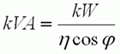
The current is said to have a phase angle ‘φ’ in relation to the voltage and the power is given by the equation
cos φ is known as the Power Factor, it is defined as the difference between the real power and the apparent power.
The effects of power factor also compound with those of load efficiency. Thus for a transformer to deliver power to a motor of efficiency η and with a power factor cos φ the rating is given by
Typically this results in required
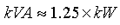
Duty Cycle
If we consider a situation whereby a transformer is powering a piece of equipment that is operating continuously on load e.g. a water pump draining an area where water is flooding in, the transformer would have to be fully rated for the power consumption of the pump. If the flooding were less severe the pump may only be turned on for a specific time period each hour just to reduce the water depth to an acceptable level. The time the pump is operational divided by the total time available is known as the Duty Cycle (expressed as a percentage).
When a transformer operates with a duty cycle, ON for a time at maximum load, kVAMAX then OFF for the remaining time during a cyclic period the required size of the unit can be reduced according to the formulae
For complex duty cycles with different loading levels for different parts of the cycle
e.g. A large machine with a cooling pump. The machine operates at full power ‘L’ for 30% of the time and just the cooling pumps at a power level ‘l’ for the remaining 70% of the cycle
Generally this equation can be written
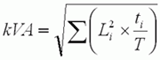
Where T is the period of the cycle
Portable Tools Transformers
Intermittent rated portable tool transformers are a specific example of transformers designed for operation with a defined duty cycle.
The standard BSEN 61558 specifies a repetitive intermittent duty cycle of 25% i.e. 5 minutes on at maximum rated load then 15 minutes off. This results in a heating and cooling cycle on the units that will ultimately stabilize at the maximum permitted temperature of operation.
A 25% duty cycle equates to a maximum continuous loading equivalent to half of the intermittent rate loading. e.g. a 3.3kVA intermittent rated transformer can deliver 1.65kVA continuously.
Non-linear Loads
Transformers that are subject to loads with large harmonic content e.g. those delivering power to a large number of D.C. power supplies also have to have their ratings adjusted for the self heating effects of the harmonics. The harmonic spectrum of the load can be defined by its K-Factor and transformers designed for these applications are referred to as K-Factor transformers.